
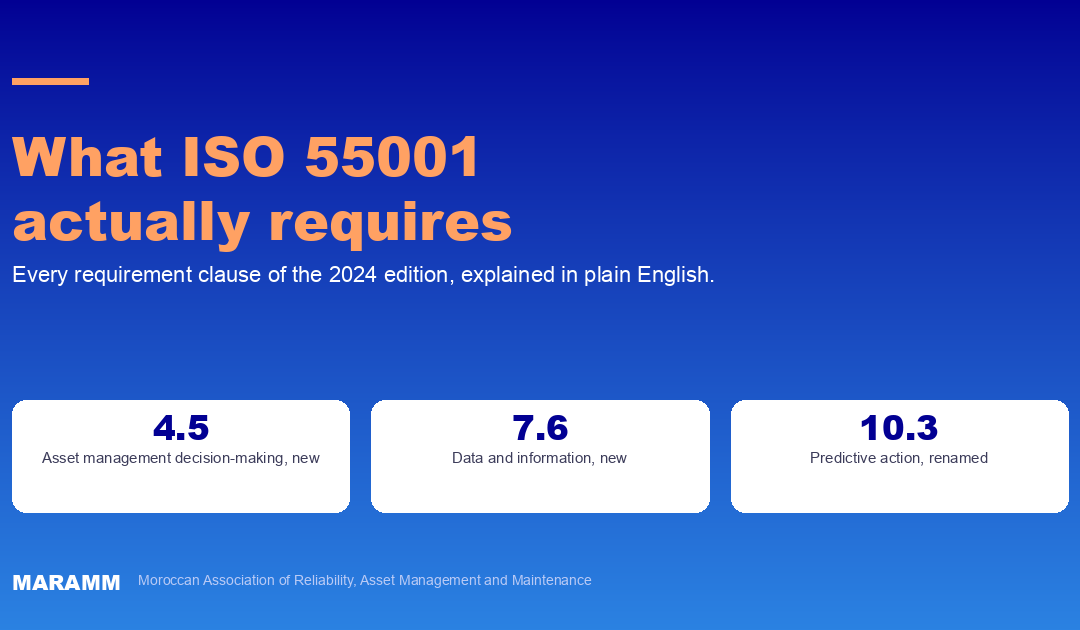
ISO 55001 is the only standard in its family you can be certified against. Its requirements run from clause 4 to clause 10. This is what each one actually asks for, in plain English, and what the 2024 edition changed.
Most of what is written about ISO 55001 online falls into two categories: a definition of asset management that tells you nothing about the requirements, or a sales page for a transition audit. The standard itself sits behind a paywall, which is legitimate, and it is written in the language of management system standards, which is not always transparent on first reading.
This article walks through the requirement clauses one by one. It explains what each asks for and what an auditor will expect to see. It does not reproduce the text of the standard, and it is not a substitute for buying it.
Where ISO 55001 sits
The 55000 series contains several documents and only one of them creates obligations.
- ISO 55000 gives the vocabulary and the principles. It explains what the words mean.
- ISO 55001 states the requirements. It is the only certifiable document in the series, and the only one an auditor can hold you to.
- ISO 55002 is guidance on applying ISO 55001. It suggests, it does not oblige.
- ISO 55010 addresses the alignment of financial and non-financial functions.
- ISO 55013, published in July 2024, covers the management of data assets.
If someone tells you an organisation is "ISO 55000 certified", the phrase is wrong. Certification is against ISO 55001, and against nothing else in the series.
Clauses 1, 2 and 3 cover scope, normative references and terms. They contain no requirement you can be audited against. Everything that obliges you starts at clause 4.
Clause 4 · Context of the organization
Four of its five sub-clauses are familiar to anyone who has worked with a management system: understand your organisation and its context (4.1), understand the needs and expectations of stakeholders (4.2), determine the scope of the asset management system (4.3), and establish the system itself (4.4).
The fifth is where the 2024 edition makes its most structural move.
4.5 Asset management decision-making
The organisation has to establish and apply a framework for asset management decision-making, sized to its own nature, size and complexity. That framework must do two things: define the value the organisation intends to draw from its assets, and define the criteria used to decide in order to realise that value. Building it, the organisation has to account for its context and objectives, the requirements of interested parties, the scope of the system, and risks and opportunities.
The criteria themselves are then governed by 4.5.2, which asks the organisation to weigh the potential impacts of a decision including when those impacts will land, how complex the decision is, how much time is available to take it, and whether it has the capability to take it properly. The standard adds a note making the trade-off explicit: the time, cost and effort spent preparing a decision should be proportionate to those four factors.
What an auditor will look for: a written framework, named criteria, and at least one real decision that can be traced through it. A framework that exists on paper but was not used for last year's renewal programme is a finding.
Clause 5 · Leadership
Leadership and commitment (5.1), the asset management policy (5.2), and roles, responsibilities and authorities (5.3).
Nothing exotic here, and that is precisely the trap. The policy has to be consistent with the organisational plan and has to be communicated. The common failure is a policy signed once, framed in a corridor, and never connected to the strategic asset management plan that clause 6 requires.
Clause 6 · Planning
6.1 Actions to address risks and opportunities
The 2024 edition separates what the previous one had merged. There is a general sub-clause (6.1.1), then actions to address risks (6.1.2), then actions to address opportunities (6.1.3), as a distinct obligation. An opportunity is no longer a footnote to a risk register.
6.2 Asset management objectives and planning to achieve them
The strategic asset management plan, the SAMP, now has its own sub-clause at 6.2.1, ahead of the objectives (6.2.2) and the planning to achieve them (6.2.3). The ordering matters: the SAMP comes first because the objectives are supposed to descend from it, not the reverse.
6.3 Planning of changes
This one is new. When the organisation determines that assets, asset management or the management system need to change, the change has to be carried out in a planned way. And the risks of any planned change, temporary or permanent, that could affect the achievement of the asset management objectives must be assessed before the change is implemented.
What an auditor will look for: pick a change made in the last twelve months, and ask for the risk assessment that preceded it. The word "before" is doing real work in this clause.
Clause 7 · Support
Resources (7.1), competence (7.2), awareness (7.3), communication (7.4) and documented information (7.5) carry over. Two sub-clauses are new, and together they are the reason this edition matters to anyone who actually runs assets.
7.6 Data and information
The organisation has to determine which data and information asset management genuinely needs. Then specify them: attributes, units of measure, quality, and source. Then build a plan for collecting, integrating, improving the quality of, and sharing that data.
It also has to set requirements for the data management processes themselves, for sharing information with interested parties, and for the alignment, consistency and traceability of information and terminology between financial and non-financial functions, documenting any difference that is deliberate.
That last requirement is where most organisations quietly fail. The asset register in the accounting system and the asset register in the maintenance system rarely describe the same objects, at the same granularity, under the same names. Nobody is at fault, and nobody owns the gap.
7.7 Knowledge
Determine the knowledge needed to operate the system, then put processes in place to use the knowledge available, keep it accessible at the moment a decision is taken, retain what exists, acquire what is new, and manage what has become obsolete. When needs or trends shift, the organisation has to reassess what it knows and decide how to update, develop, acquire or access what it lacks.
The phrase about accessibility at the moment of decision is the operative one. Knowledge filed in a drive that nobody opens during an arbitration does not satisfy this clause.
Clause 8 · Operation
8.1 Operational planning and control including life cycle management
The title now carries life cycle management explicitly. The standard's own notes make the span clear: life cycle processes can include creation, acquisition, operation, maintenance, improvement, renewal and disposal. Acquisition is not only purchase: it covers leasing, design, development, installation and commissioning, and capability made available through arrangements such as a public-private partnership or a build-own-operate scheme. Disposal includes extinguishing the liability attached to owning, managing or operating the asset.
That note on disposal deserves attention from anyone operating under a delegated service contract. Handing an asset back at the end of a contract is a life cycle activity governed by this clause, not an administrative formality.
8.2 Control of change · 8.3 Externally provided processes, products, technologies and services
Change is now handled at two levels: planned at 6.3, controlled in operation at 8.2. And 8.3 covers what you outsource, which for most infrastructure owners is the majority of what actually touches the asset.
Clause 9 · Performance evaluation
Monitoring, measurement, analysis and evaluation (9.1). Internal audit, split into general requirements (9.2.1) and the audit programme (9.2.2). Management review, split into general requirements (9.3.1), management review inputs (9.3.2) and management review results (9.3.3).
The split of the management review into inputs and results is worth noting: it makes it harder to hold a review that produces minutes but no decisions.
Clause 10 · Improvement
Continual improvement (10.1) and nonconformity and corrective action (10.2) are conventional. The third sub-clause is not.
10.3 Predictive action
ISO states in its own foreword that the sub-clause previously called "preventive action" has been renamed "predictive action", with a full technical revision of its content.[1] This is the deepest change in the edition.
The organisation must establish processes to predict when decisions about assets, asset management and the management system will be needed. In building them, it has to consider determining the occurrences and impacts of nonconformities and of improvement initiatives; determining optimal intervention points, for instance for maintenance, renewal, replacement and disposal of assets; and identifying the inputs needed to establish the relationship between asset condition and performance, opportunity, risk and cost, and to determine depreciation and financial value.
It must then report to relevant interested parties on the long-term effect of decisions taken from predictive action.
Read 7.6 and 10.3 together, or neither works.
You cannot determine an optimal intervention point without a measured condition, a cost, and a relationship between the two. Clause 10.3 turns condition data from good practice into an obligation, and clause 7.6 is where that data gets specified. An organisation that treats 7.6 as a documentation exercise will not be able to satisfy 10.3, and the gap will only surface at the audit.
What the 2024 edition changed
BSI's own guidebook for its certified clients singles out four clauses as the changes compared with the 2014 edition: 4.5 asset decision-making, 6.2.1 strategic asset management plan, 7.7 knowledge, and 10.3 predictive action.[2]
To those, reading the current edition against the previous structure adds: the explicit separation of risks and opportunities in 6.1, the new planning of changes at 6.3, the new data and information requirement at 7.6, and the appearance of life cycle management in the title of 8.1.
Your deadline is probably not the one you have been told
European Accreditation resolution 2024 (56) 07, adopted on 21 November 2024, sets the transition at three years from the last day of the month of publication.[3] The timeline it fixes is precise:
- 31 January 2026 · national accreditation bodies ready to carry out transition assessments.
- 31 July 2026 · certification bodies cease conducting initial and recertification audits to ISO 55001:2014.
- 31 July 2027 · certification bodies shall have completed all transitions of certified clients. All ISO 55001:2014 certifications expire or are withdrawn.
But that is the accreditation-level date, not necessarily yours.
BSI tells its own certified clients that the three-year transition concludes on 28 July 2027, that one extra day has to be added to the audit duration when the transition takes place, and that it can happen during a surveillance or a recertification audit.[2]
Three days earlier than the accreditation deadline, and an audit day you have to budget for. A certification body is entitled to set an internal date ahead of the accreditation one. We have verified a single case, which is enough to make the point: the accreditation calendar is not automatically yours. The only reliable answer to "when is my deadline" comes from your own certification body, in writing.
One consequence is already past. Since 31 July 2026, initial and recertification audits against the 2014 edition have stopped. A nuance matters here and is often stated too broadly: it is the audit that ceased, not the decision. An audit conducted before that date could still support the granting or renewal of a 2014 certificate afterwards.
This article explains requirements in its own words. It does not reproduce the text of ISO 55001:2024, which is protected by copyright and sold by ISO and its national members. Anyone implementing or auditing the standard needs their own licensed copy, available from ISO. There is no substitute, and this page is not one.
Sources
- ISO. ISO 55001:2024, Asset management, Asset management system, Requirements, second edition published 3 July 2024. Clause structure and requirement content read from a licensed copy. The standard is sold by ISO and its national member bodies. iso.org
- BSI. PP1309 ISO 55001 Asset Management Guidebook, June 2026, sections 12 on transition arrangements and 13 on changes compared to ISO 55001:2014. Client guidance document, searchable by its reference PP1309.
- European Accreditation. Resolutions of the 56th EA General Assembly, resolution EA 2024 (56) 07, adopted 21 November 2024. Published by EA and mirrored by several national accreditation bodies.
Going further
Reading the clauses is one thing. Being audited against them is another.
The 2024 edition asks for a decision-making framework, specified data, accessible knowledge and predictive processes. Each of those has to exist as evidence, not as intention. MARAMM trains and certifies on ISO 55001:2024.
ISO 55001 Lead Implementer and Internal AuditorFor an overview of the standard itself, see ISO 55001 asset management. On clause 7.6 and data as an asset, see our article on ISO 55013 and the shelf life of asset data (in French).