
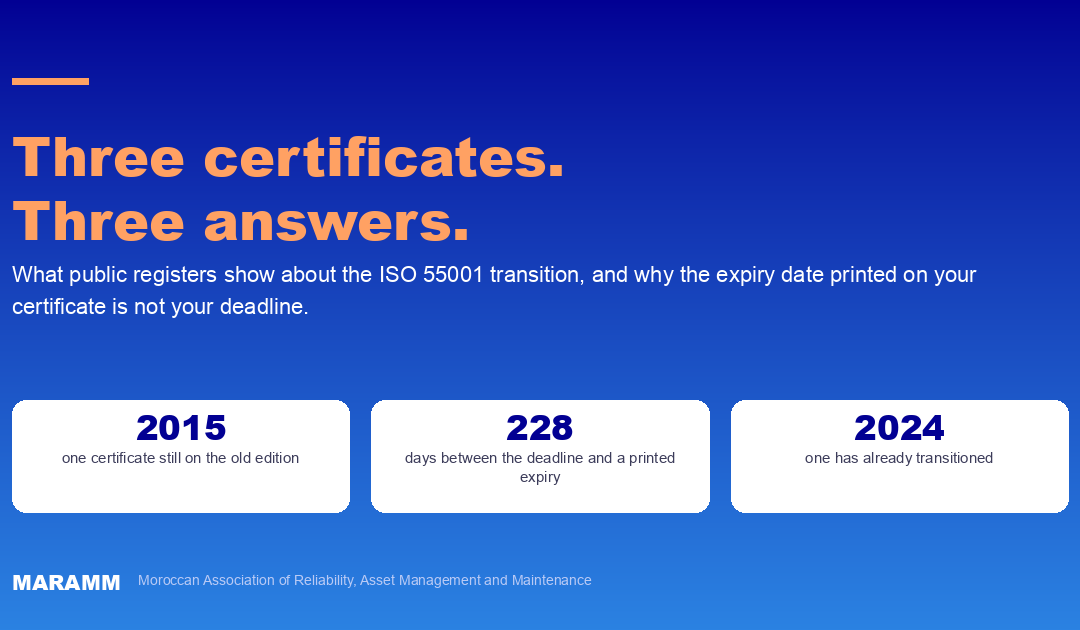
Three organisations hold an ISO 55001 certificate today. One has not moved since 2019. One holds a certificate that expires seven months after the deadline that will withdraw it. One has already transitioned. All three were checked in the issuers' own public registers, and anyone can check them again in under a minute.
Ask how long ISO 55001 certification takes, or when a certificate really expires, and you will find no published answer. That is not an accident. The people who know precisely are the certification bodies, and they quote per case. The consultants who implement quote per case too. Nobody has an interest in publishing a general answer.
But certificate registers are public. They are just never read. So we read three of them.
Three certificates, checked in September 2026
| Organisation | Certificate | Edition shown today |
|---|---|---|
| Serveo Servicios, S.A.U. Spain | GAC-2019/0002, AENOR | UNE-ISO 55001:2015 |
| E-REDES, S.A. Portugal | PT22/00000012, SGS United Kingdom | ISO 55001:2014, valid to 15 March 2028 |
| Atlantic Copper, S.L.U. Spain | GAC-2019/0003, AENOR | UNE-ISO 55001:2024 |
UNE-ISO 55001:2015 is the Spanish adoption of the 2014 international edition. A certificate showing it is a 2014-edition certificate.
Nothing has moved
Serveo Servicios holds AENOR certificate GAC-2019/0002, covering the life cycle management of residential, land, tertiary and other real estate assets owned by its client, at a single site in Madrid. The certificate number carries its year of issue. Seven years later, the register still shows the 2015 adoption.
There is nothing irregular about that. It simply means the transition has not happened yet, and the clock described below is running.
The certificate that outlives its own deadline
E-REDES, the Portuguese electricity distribution operator, holds certificate PT22/00000012, issued by SGS United Kingdom Limited under UKAS accreditation. Its scope covers the asset management system for HV, MV and LV electricity distribution networks across all phases of their life cycle. The register shows the standard as ISO 55001:2014, the status as valid, and the expiry date as 15 March 2028.[2]
That expiry date is 228 days after the deadline at which the certificate ceases to exist.
European Accreditation resolution 2024 (56) 07 states that all ISO 55001:2014 certifications shall expire or be withdrawn at the end of the transition period, which it fixes at 31 July 2027.[3] UKAS, the accreditation body named on this certificate, is a member of European Accreditation.
Nothing here is a fault of the certified organisation or of its certification body. A certificate is issued for a normal three-year cycle, and the printed expiry date is that cycle date. The transition rules override it. But an asset manager who plans from the document in their hand, and only from that, is planning seven and a half months past the point at which their certificate no longer exists.
Already done
Atlantic Copper holds AENOR certificate GAC-2019/0003, and the register shows UNE-ISO 55001:2024. Four sites are included, at the Huelva metallurgical complex. The scope covers the life cycle of the physical assets used to produce copper cathode and copper anode from copper concentrate, sulphuric acid from metallurgical gases, iron silicate and gypsum, and to generate electricity.[1]
This is the useful half of the comparison. A heavy industrial site, with four locations and a genuinely complex asset base, has completed the transition while others have not started. Whatever the obstacle is, it is not the nature of the assets.
The transition calendar, from the resolution itself
Four dates, set by European Accreditation resolution 2024 (56) 07, adopted on 21 November 2024. They run three years from the last day of the month in which the revised standard was published.
31 January 2026. National accreditation bodies ready to carry out transition assessments.
31 July 2026. Certification bodies cease conducting initial and recertification audits against the 2014 edition. This date has passed.
31 July 2027. Certification bodies shall have completed all transitions of certified clients. All 2014 certifications expire or are withdrawn.
One nuance is regularly stated too broadly, including by us before we read the text: it is the audit that stopped in July 2026, not the decision. An audit conducted before that date could still support the granting or renewal of a 2014 certificate afterwards. That is how a 2014 certificate can carry a 2028 expiry date and still be entirely regular.
And the accreditation date is not necessarily your date either.
BSI tells its own certified clients that the three-year transition concludes on 28 July 2027, that one extra day must be added to the audit duration when the transition takes place, and that it can happen during a surveillance or a recertification audit.[4] Three days earlier than the accreditation deadline, and an audit day to budget for.
A certification body is entitled to set an internal date ahead of the accreditation one. We have verified one case, which is enough to establish the principle. The only reliable answer to "when is my deadline" comes from your own certification body, in writing.
So how long does it actually take?
We are not going to publish a number of months we have not measured. Every figure you find quoted is either a sales estimate or a single case presented as a rule.
What the registers do show is the structure: certification runs on a three-year cycle, with surveillance audits in between, and the transition can be folded into one of those audits rather than requiring a separate exercise. The audit itself is measured in days.
The audit is not where the time goes. It goes into what the 2024 edition now requires you to be able to show.
- Clause 4.5 asks for a documented decision-making framework, with named criteria, sized to your organisation. Writing it takes weeks. Getting a real investment decision to actually pass through it takes a budget cycle.
- Clause 7.6 asks you to specify your data: attributes, units of measure, quality, source. And to align terminology between financial and non-financial functions. On most asset bases, the accounting register and the maintenance register do not describe the same objects under the same names, and reconciling them is a project in itself.
- Clause 10.3 asks for processes that predict when a decision will be needed, including determining optimal intervention points and the relationship between asset condition, performance, risk and cost. You cannot establish that relationship without measured condition data over time. If you do not have the history, you cannot buy it.[5]
That is where the honest answer sits. The binding constraint is not the audit, and it is not the documentation. It is whether you hold data about the condition of your assets, and for how long you have been holding it. An organisation with ten years of condition records and no management system is closer to certification than an organisation with a full manual and no measurements.
How to check any certificate yourself
Two routes, and both are free.
Each certification body publishes a directory of its certified clients, searchable by certificate number or company name. That is where the three certificates above were read. Expect the entry to show the standard and its edition, which is the field that matters here, along with the status, the scope and usually the accredited sites.
Above the certification bodies, the International Accreditation Forum operates IAF CertSearch, a global database of accredited certificates fed by accreditation and certification bodies. ISO points to it as the way to verify an accredited certification. It is the better starting point when you do not know which body issued a certificate.
A practical note for anyone checking a supplier or a partner: the edition shown in the register is the fact, not the logo on a presentation slide. Between now and 31 July 2027, "certified to ISO 55001" stops being a sufficient statement. The edition is the statement.
Sources
- AENOR. Public certificate register, entries GAC-2019/0002 for Serveo Servicios, S.A.U. and GAC-2019/0003 for Atlantic Copper, S.L.U., consulted 13 September 2026. Searchable by company name in the AENOR certificate finder.
- SGS. Certified Client Directory, entry PT22/00000012 for E-REDES, Distribuicao de Eletricidade, S.A., consulted 13 September 2026. Issued by SGS United Kingdom Limited under UKAS accreditation.
- European Accreditation. Resolutions of the 56th EA General Assembly, resolution EA 2024 (56) 07, adopted 21 November 2024.
- BSI. PP1309 ISO 55001 Asset Management Guidebook, June 2026, section 12 on transition arrangements.
- ISO. ISO 55001:2024, Asset management, Asset management system, Requirements, second edition published 3 July 2024. Clause content read from a licensed copy. iso.org
Going further
The transition is an audit. Getting through it is a data problem.
Clause 7.6 wants your data specified. Clause 10.3 wants condition related to cost. Neither can be written the week before the audit. MARAMM trains and certifies on ISO 55001:2024, and works on the evidence before the evidence is asked for.
ISO 55001 Lead Implementer and Internal AuditorFor what each clause actually requires, see what ISO 55001 actually requires, clause by clause.