
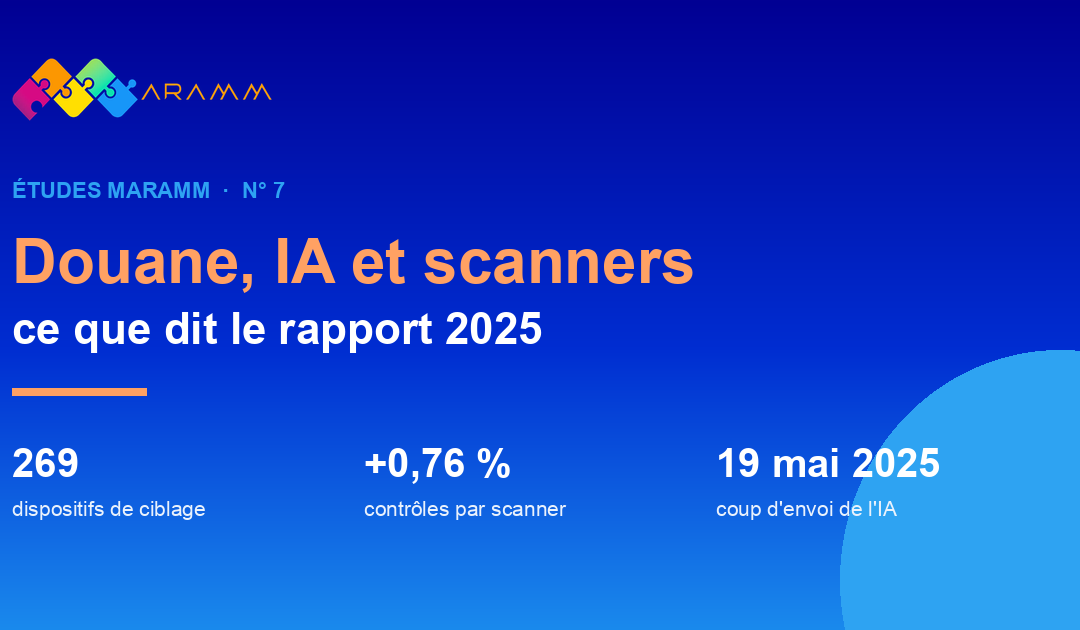
Moroccan customs closed 2025 on record results: MAD 161 billion in revenue, seizures of smuggled goods up 36.6 %, contraband cigarettes multiplied by more than three. The press credited artificial intelligence. The administration's own activity report does not. It names something else: a rules engine, 269 targeting mechanisms, and one more scanner.
What the report credits, and to what
The 2025 activity report of the Customs and Excise Administration (ADII) is a public document of 17,622 words in its French version.[1] It devotes a full chapter to control and the fight against fraud, and it explains where its results come from. The sentence that matters, in the administration's own English version, is this one:
A rules engine is not a learned model. It is a deterministic system: conditions are written into it, and it applies them. Two identical declarations produce the same decision twice, and an inspector can always say why a shipment was held. It is a proven, auditable technology, and it is the one the report credits.
The same section lists what completed this upgrade: "radiocommunication networks, vehicle geolocation systems, body-worn and endoscopic cameras, X-ray scanning technology, as well as personal protective equipment, measuring instruments for petroleum product, and traceability solutions for precious metals and gemstones". The French and Arabic versions of the report are more precise on one point: they speak of the installation of one additional X-ray scanner. And the report concludes: "Collectively, these capabilities have markedly strengthened operational agility and field responsiveness."
Rules and equipment. No learning algorithm.
The figure the report does not give
If the results came from more intensive physical control, the number of scanner passes should have risen with them. The 2025 report does not allow this to be checked: it publishes no national figure for scanner-based controls. The only one it gives sits in its "Focus on regions" section, on the page of the Customs Directorate of the Port of Casablanca:
At the Kingdom's first port, scanner-based control therefore stayed flat and fell 10 % on imports, while the national indicators in the same report rose: declarations up 4 %, revenue up 11 %, seized smuggled goods up 36.6 %, cigarettes up 231 %. This figure calls for two reservations. It holds for Casablanca only, and nothing allows it to be extended to the country. And the port's directorate was reorganised in 2025, with part of its units transferred to the Tele-Control Directorate: its own revenue is down 26.4 % in the same report, which weakens any year-on-year comparison.
What can be said fits in two sentences. The report itself attributes the 2025 results, in the passage quoted above, to the rules engine and the 269 targeting mechanisms: what changed is the way of choosing what to control. And the administration, which publishes its seizures to the kilogram, does not publish how many times its scanners were used across the country. That absence is the first piece of the blind spot this study documents below.
Note on the French original
The first version of the French study, published on 25 September 2026, presented the Casablanca port figure as a national one and compared it, in a table, with the national indicators of the same report. The French text was corrected on 28 October 2026; this translation follows the corrected text.
Artificial intelligence, in the future tense
AI is not absent from the 2025 report. It appears three times, and never as a system in production. The main mention describes a project:
The report dates this launch: "the official launch took place on May 19, 2025 in Rabat", and an assistance mission was held from 19 to 23 May at the administration's headquarters, on "Support for Control Operations and the Implementation of AI-Based Risk Analysis and Targeting Technologies".
The previous year's report said the same thing, also in the future tense:[2] "The Customs is also looking to take advantage of the use of Artificial Intelligence (AI) in its various control processes, and is planning to integrate it into the implementation of a predictive analysis system, the interpretation of images from scanners, and any other field relevant to its missions."
What the AI will read: scanner images
The first announced use deserves attention, because it changes the nature of the problem. The ADII does not only plan to apply AI to declarative data. It plans to apply it to the interpretation of the images produced by X-ray scanners.
A vision model does not read a shipment: it reads an image of that shipment. Its performance is therefore bounded by what the sensor produces. A detector ages, its response drifts, its noise rises, its effective resolution falls. An X-ray generator loses stability. A misadjusted conveyor changes the geometry of the acquisition. None of this stops an experienced human operator from working: they compensate, they ask for another pass, they know that a given machine "shoots darker". A model trained on the images of a device in a given state does not compensate. It degrades with the sensor, silently, and its confidence score does not say so.
This is a classic asset management problem, disguised as an artificial intelligence problem. The announced performance of a vision system is a function of the condition of a fleet.
What the report does not say about that fleet
We searched, term by term, for what the reports publish about the control equipment itself. The result is the same in both financial years. The count below was made on the French version of the 2025 report.
| Term searched (French version) | Occurrences (2025 report, 17,622 words) |
|---|---|
| availability (disponibilité) | 0 |
| maintenance | 0 |
| life cycle (cycle de vie) | 0 |
| calibration (étalonnage) | 0 |
| renewal (renouvellement) | 1 (unrelated to equipment) |
| fleet (parc) | 4 |
The four occurrences of parc refer to a lorry park at the future Agadir dry port, a children's playground at a holiday centre, and two career paths (parcours). Never the fleet of control equipment. The same count on the 25,992 words of the English 2024 report, with every context checked one by one, gives the same zeros: the two occurrences of maintenance refer to the maintenance of an anti-dumping duty, and the seven of equipment to officers' uniforms and to import statistics for capital goods.
Nor does the report publish the number of scanner-based control operations for the country as a whole: the only figure available, quoted above, is the Port of Casablanca's.
Why this gap matters now
It matters because public reasoning about customs is shifting. As long as targeting rested on rules written by inspectors, the question of physical resources was simple: how many scanners, how many officers, how many passes. Once a model reads the images, the question becomes: what is the quality of the images it learned from, and what will be the quality of the images it reads tomorrow?
This is exactly what ISO 55001, in its 2024 edition, strengthened. Its clause 7.6 requires an organisation to specify the attributes of its data, their quality and their source, and its clause 4.5 introduces the requirement to have confidence in the information on which a decision rests.[4] ISO 55013, published the same year, extends this reasoning by treating data sets as assets in their own right.[5] A scanner image is precisely that: a piece of data whose value depends on the condition of the equipment that produced it.
The 2025 report also mentions two institutional developments that point the same way: the creation of a National Supervision and Control Center, which "marks a significant step forward in leveraging advanced technologies to monitor trade flows more effectively", and the upgrade of the Casablanca and Tangier Regional Tele-Control Centers to full Directorate status. Two regions which alone account for 87.4 % of the Kingdom's declarations. The more decisions are centralised and automated, the more the quality of what they observe becomes structural.
Three indicators nobody would miss
Nothing above calls for a reform. Three indicators, already kept internally by any administration that operates heavy equipment, would be enough to make the debate verifiable:
- The fleet and its age. How many non-intrusive inspection devices, located where, commissioned when. One figure a year, without sensitive operational detail.
- Availability. The fleet's annual availability rate, or failing that, the number of devices out of service for more than thirty days. It is the indicator that would make it possible to understand why, at the Port of Casablanca, import scanning falls 10 % while declarations rise.
- The renewal plan. The horizon at which devices reach the end of their technical life, and what is scheduled. It is the data that tells whether a vision AI will have stable images to work on.
Publishing these three lines reveals no vulnerability: neither the location of a given device, nor its sensitivity, nor the targeting thresholds. It simply makes debatable what today is not.
What this reading teaches beyond customs
The case is Moroccan, the mechanism is not. Wherever an administration announces artificial intelligence applied to a physical flow, the same question arises: on which sensors, in what condition, with what replacement plan. The results of a control are published to the kilogram and the dirham, because they are politically legible. The condition of the machines that make that control possible almost never is, because it is not.
That is the gap this series sets out to document: not a failing, but an information asymmetry that prevents judgement on the evidence. And it narrows by itself, as soon as three figures that are already held are published.
Sources
- douane.gov.ma. Customs and Excise Administration, Annual Report 2025, English version, 2026 (quotations), and Rapport d'activité 2025, French version (word count and term search). Chapters "Control and fight against fraud", "Customs in figures", "Message from the Director General" and "Focus on regions" (Customs Directorate of the Port of Casablanca). http://www.douane.gov.ma/dms/loadDocument?documentId=98138 and documentId=98136
- douane.gov.ma. Customs and Excise Administration, Annual Report 2024, English version, 2025. Section "Objective 5". http://www.douane.gov.ma/dms/loadDocument?documentId=96470
- douane.gov.ma. Customs and Excise Administration, press room, releases of 26 June 2026 (China) and 18 September 2026 (Russia). Consulted on 26 September 2026. https://www.douane.gov.ma/presse/
- iso.org. ISO 55001:2024, Asset management, Asset management system, Requirements, second edition. Clauses 4.5 and 7.6, read on a licensed copy. https://www.iso.org/standard/83054.html
- iso.org. ISO 55013:2024, Asset management, Guidance on the management of data assets. https://www.iso.org/standard/82455.html
Related, in French
- Une IA qui pense, c'est une ville qui boit (an AI that thinks is a city that drinks)
- ISO 55013 : la donnée d'actif se périme plus vite que l'actif (asset data expires faster than the asset)
This study is a translation of the French original, published on 25 September 2026 and corrected on 28 October 2026. Quotations from the 2025 report are taken from the administration's own English version; the term count was made on the French version.