
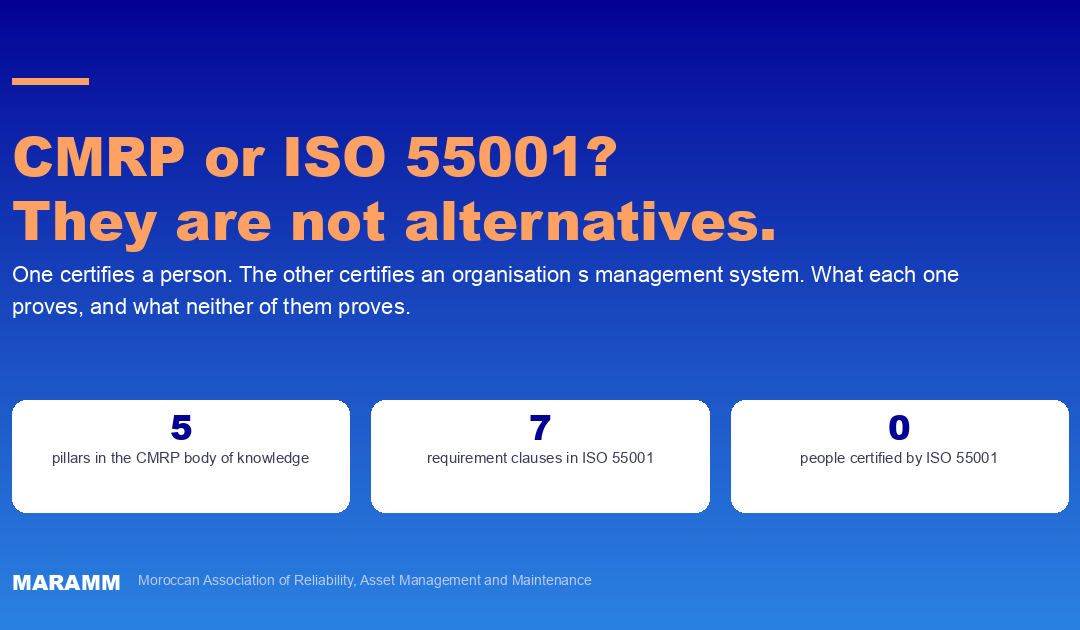
The question is almost always asked as a choice. It is not one. The CMRP certifies a person. ISO 55001 certifies an organisation's management system. Picking between them is a category error, and it costs organisations real money when they get it the wrong way round.Search for the two together and you will find comparison pages written by people who sell one of them, and at least one site whose business is selling exam dumps. What follows is what each one actually certifies, what neither proves, and how to tell which you need.
The category error
A certificate answers a question. The two certificates answer different questions.- The CMRP answers: does this individual command the body of knowledge of maintenance and reliability?
- ISO 55001 answers: does this organisation run a management system that meets the requirements of the standard?
5pillars in the CMRP body of knowledge
7requirement clauses in ISO 55001, from 4 to 10
1person certified by the CMRP
0people certified by ISO 55001
What the CMRP certifies
The Certified Maintenance & Reliability Professional is awarded by the Society for Maintenance & Reliability Professionals. It attests that a practitioner commands the five pillars of the SMRP Body of Knowledge.| Business & Management | Translating business objectives into maintenance and reliability activity, and justifying it. |
| Manufacturing Process Reliability | The reliability of the process itself, not only of the equipment that serves it. |
| Equipment Reliability | Failure modes, condition, and the decisions that follow from them. |
| Organization & Leadership | People, structure, competence and the way work is organised. |
| Work Management | Planning, scheduling, execution and the loop back into the record. |
What ISO 55001 certifies
ISO 55001 states requirements for an asset management system. Certification against it is granted to an organisation, for a defined scope, by a certification body that is itself accredited. It runs on a three-year cycle with surveillance audits in between.The requirements run from clause 4 to clause 10: the context of the organisation and its decision-making framework, leadership, planning, support including data and knowledge, operation including life cycle management, performance evaluation, and improvement including the predictive action that the 2024 edition introduced.[2]No individual is certified by this process. A person can be trained and examined as a Lead Implementer or an internal auditor, and that is a personal credential too, but it is not the same thing as the organisation's certificate.Side by side
| CMRP | ISO 55001 | |
|---|---|---|
| Subject | A person | An organisation, for a defined scope |
| Awarded by | The SMRP | An accredited certification body |
| Assessed by | An examination | An audit, against documented evidence |
| Portable | Yes, it follows the holder | No, it stays with the organisation and the scope |
| Prerequisite | Field experience | A system that exists and produces evidence |
| Appears in a public register | Through the awarding body | Yes, with the edition of the standard shown |
Where they touch
A caution before the mapping below.The five pillars and the seven requirement clauses were not written to correspond to each other, and no official crosswalk exists between them. What follows is our own reading of where the subject matter overlaps. It is useful for deciding what to work on first. It is not a compliance mapping, and it should not be presented to an auditor as one.
- Business & Management meets clause 4.5, the decision-making framework. Both ask the same thing: on what criteria do you arbitrate, and can you show it.
- Work Management meets clause 8.1, operational planning and control including life cycle management. Planning, scheduling, execution, and the record that closes the loop.
- Equipment Reliability meets clause 10.3, predictive action, which now requires processes that determine optimal intervention points and relate asset condition to performance, risk and cost.
- Organization & Leadership meets clauses 5 and 7.2, leadership and competence.
- Manufacturing Process Reliability has no direct counterpart. ISO 55001 is deliberately sector-neutral; it does not prescribe technique. This pillar is where the CMRP goes somewhere the standard does not.
So which do you need?
Three situations, and the answer differs in each.You are a practitioner. The CMRP is the credential that travels with you and that an employer can read without knowing your previous organisation. ISO 55001 certification is not available to you as an individual.Your organisation is asked for ISO 55001 by a client, a regulator or a funder. Then the organisation needs the certificate, and no number of certified individuals substitutes for it. What certified individuals do is make the system worth auditing.You want your maintenance to actually improve. Then start with people. A management system built by people who have not mastered the body of knowledge produces documentation, passes an audit, and changes nothing on the shop floor.
What neither of them proves
This is the part that the pages selling either one leave out.A CMRP does not make your organisation compliant. It is a personal credential. Ten certified practitioners in an organisation with no documented decision framework, no specified data and no predictive processes will fail an ISO 55001 audit, and they will be right to fail it, because the system does not exist.An ISO 55001 certificate does not make your people competent. Clause 7.2 requires competence to be determined and evidenced, but a certificate on the wall says nothing about the depth of the individuals behind it.And a certificate does not say what you think it says unless you read the edition. Between now and 31 July 2027, every ISO 55001 certificate is either on the 2014 edition or the 2024 one, and the difference is substantial. We read three real certificates in their issuers' public registers, and one of them expires 228 days after the deadline that withdraws it.[3]A note on our position. MARAMM trains for both: preparation for the CMRP examination, and Lead Implementer and internal auditor training on ISO 55001. We do not award the CMRP, which is the SMRP's, and we do not certify organisations against ISO 55001, which is an accredited certification body's role. That separation is why this comparison can be written honestly.
Sources
- SMRP. The five pillars of the SMRP Body of Knowledge and the eligibility conditions for the CMRP examination, as taught in MARAMM's preparation programme.
- ISO. ISO 55001:2024, Asset management, Asset management system, Requirements, second edition published 3 July 2024. Clause structure read from a licensed copy. iso.org
- MARAMM. Three ISO 55001 certificates read in the public registers of AENOR and SGS, September 2026. Certificate numbers and editions given in the linked article.
Going further
Most organisations need both, in an order.
People first, then the system that makes their work demonstrable. MARAMM prepares practitioners for the CMRP examination across the five pillars, and trains Lead Implementers and internal auditors on ISO 55001:2024.CMRP certification trainingOn the standard itself, see what ISO 55001 actually requires, clause by clause, and the Lead Implementer and internal auditor programme.